X-Pro · 2019 · discontinued
Fujifilm X-Pro3 review
Launch price 1,799 USD · 26.1 MP X-Trans IV sensor · 4K 30p video
Also written XPro3 or X Pro3.

Unique hidden rear LCD and a hybrid OVF/EVF. Made for documentary and street photographers.
Verdict
Documentary and street-oriented rangefinder with a unique hidden rear LCD, hybrid OVF/EVF, and weather-sealed build. 26.1 MP X-Trans IV sensor, 4K/30p F-Log, dual SD UHS-II. At 1799 USD it is a specialist tool, no IBIS, fixed screen.
Documentary and street photographers who want an optical viewfinder with Fuji color.
In detail
Long ago I wrote about how rangefinders change the way you shoot, and the X-Pro3 is the camera that keeps pulling me back to that idea. Buyers usually come to it looking for Fuji's well-tried 26 MP X-Trans IV sensor and the price point it launched at. Released in 2019 at 1,799 USD, the body is no longer in production. It sits in the X-Pro line, Fuji's rangefinder-style line with the optical/electronic hybrid viewfinder.
The sensor pulls more detail than older 26 MP bodies, especially in good light. At 26.1 MP, native ISO runs ISO 160 to 12800, and the files give you enough room to crop without falling apart. Face and eye detection is on board and works well for portraits and street. Burst at 11 fps is plenty for travel, family, and most outdoor work.
If you only need solid 4K for the web, this is comfortably enough. 4K 30p covers the resolution most people actually deliver, and the bitrates are sensible.
In the hand it feels like a Fuji, with the usual tight dials, a deep enough grip, and weather sealing on the bodies that target working photographers. There is no in-body stabilization, so for low light or long lenses you will lean on stabilized XF glass. At 497g it sits in the comfortable middle, light enough for travel but solid in the hand.
Battery life is 400 shots per charge by CIPA, a full day of mixed shooting if you are not chimping the EVF constantly. Two card slots are present, both taking SD UHS-II, so you can shoot with a backup or split RAW/JPEG. Bottom line: this is the X-Pro body to look at if you want Fuji's rangefinder experience without jumping to a flagship.
Pros and cons
What we like
- Hybrid OVF/EVF unique to the X-Pro line
- Hidden rear LCD encourages waist-level shooting
- Dual SD UHS-II slots, weather sealed
- Titanium-style top and bottom plates
The headline win is the hybrid OVF/EVF unique to the X-Pro line, a viewfinder that genuinely changes how you see a scene. Film simulation count is 8, the older but still solid lineup. Dual card slots give event and travel shooters the kind of redundancy that used to require a full-frame body. On the video side, 4K 30p is more than enough for most hybrid shooters, and the Fuji film simulations translate to video just as well.
Trade-offs
- No in-body stabilization
- Rear LCD is fixed, folds down to hide
The honest trade-off is no in-body stabilization. That means relying on stabilized lenses for low light. The XF 18-55mm kit zoom, the 16-80mm f/4 and the 50-140mm f/2.8 have OIS; the fast primes do not, so with a 23mm or 35mm on the front shutter speed is your only lever. The hidden LCD is great for slow, deliberate work, but if you chimp a lot, you will hate it. The 400-shot battery is also on the lean side for a full day of street walking.
Who is this for
Documentary and street photographers who want an optical viewfinder experience with Fuji color. Travel videographers and YouTubers running a one-person crew can absolutely get by with this body. Anywhere the experience of shooting matters as much as the file.
Photos shot on the X-Pro3
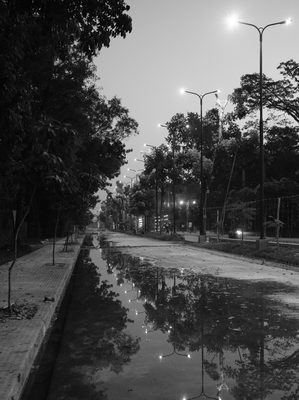
We shot and published 14 frames on the X-Pro3, April 2023 to November 2025. Click any thumbnail for the full-size file and its settings on masnun.photos. These are edited photographs, not resolution tests — read them as a record of what the camera actually gets used for.













X-Pro3 release date and lifecycle
The Fujifilm X-Pro3 was announced in October 2019.
| Announced | |
|---|---|
| Launch price | 1,799 USD |
| Status | Discontinued |
| Replaced | X-Pro2 |
Announcement month is from Fujifilm’s launch announcement; the on-sale month is not recorded for this body. Launch price is MSRP at release, not a used-market price.
Full specifications
| Release year | 2019 |
|---|---|
| Launch price | 1,799 USD |
| Status | Discontinued |
| Megapixels | 26.1 MP |
| Sensor generation | X-Trans IV |
| Processor | X-Processor 4 |
| ISO range | 160–12800 |
| AF points | 425 |
| Subject detection | face-eye |
| Burst (fps) | 11 |
| Max video | 4K 30p |
| Codec | H.265, H.264 |
| Log profile | F-Log |
| Stabilization | None |
| Viewfinder | Hybrid OVF/EVF (3.69M dot) |
| LCD | 3" fixed touch |
| Weather sealed | Yes |
| Weight | 497g |
| Card slots | 2 |
| Card types | SD UHS-II / SD UHS-II |
| Battery | NP-W126S |
| Battery life (CIPA) | 400 shots |
| Film sims | 7 |
Highlighted rows are class-leading within the current Fujifilm APS-C lineup.
Film simulations (7)
- PROVIA
- Velvia
- ASTIA
- Classic Chrome
- Classic Neg.
- ACROS
- ETERNA
Compared with




Fujifilm X-Pro3 vs siblings
How the X-Pro3 stacks up against the closest siblings in the current Fujifilm lineup.
Fujifilm X-Pro3 vs X-Pro1
The Fujifilm X-Pro3 and Fujifilm X-Pro1 are both Fujifilm X-Pro bodies. The X-Pro3 is the newer of the two, arriving in 2019. At launch the X-Pro3 was 1,799 USD and the X-Pro1 1,699 USD, making the X-Pro1 the more affordable of the two.
Fujifilm X-Pro3 vs X100VI
The Fujifilm X-Pro3 and Fujifilm X100VI are Fujifilm APS-C bodies from different lines — the X-Pro and the X100. The X100VI is the newer of the two, arriving in 2024. At launch the X-Pro3 was 1,799 USD and the X100VI 1,599 USD, making the X100VI the more affordable of the two.
Further reading
Where to buy
The link below runs an Amazon search for this camera rather than pointing at one listing, because stock and sellers move around. As an Amazon Associate we earn from qualifying purchases — at no extra cost to you.

See it in the wild
Owner impressions and real-world photos from the Fuji community.

