Fujifilm X-T10 vs X-M1: full comparison
The X-T10 leads on more headline specs, but the X-M1 counters on a lighter 330g body.
Also searched as XT10 vs XM1, and in the other order as XM1 vs XT10.
Not sure which one fits? Take the Fujifilm camera quiz and we will score both bodies against your answers.
The short version
The Fujifilm X-T10 and Fujifilm X-M1 are Fujifilm APS-C bodies from different lines — the X-T and the X-M. The X-T10 is the newer of the two, arriving in 2015. At launch the X-T10 was 799 USD and the X-M1 699 USD, making the X-M1 the more affordable of the two.
On paper the X-T10 is the stronger body of the two. It gives you 8 fps continuous shooting, 1080p/60p video, and a 2.36M-dot electronic viewfinder.
The X-M1 isn't far behind. It hits back with a lighter 330g body.
So which one? If you want 8 fps continuous shooting, get the X-T10. If a lighter 330g body is closer to what you actually need, the X-M1 is the smarter buy. And the X-M1 costs less — 699 USD at launch.
Where the X-T10 wins
- +8 fps continuous shooting
- +1080p/60p video
- +a 2.36M-dot electronic viewfinder
Where the X-M1 wins
- +a lighter 330g body
Who should buy the X-T10 or X-M1?
Buy the X-T10 if…
Pick the X-T10 if 8 fps continuous shooting, 1080p/60p video matters to you. It is the better fit for buyers who already lean toward X-T handling. Read the full X-T10 review for the use-case-specific pros and cons.
Buy the X-M1 if…
Pick the X-M1 if a lighter 330g body matters to you. It also launched cheaper at 699 USD. It is the better fit for buyers who already lean toward X-M handling. Read the full X-M1 review for the use-case-specific pros and cons.
X-T10 vs X-M1: pros and cons
| Fujifilm X-T10 | Fujifilm X-M1 |
|---|---|
|
|
|
|
Pros and cons mirror the in-house X-T10 review and X-M1 review.
X-T10 vs X-M1: full specs
| Spec |  X-T10 X-T102015 · $799 | 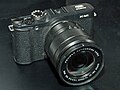 X-M1 X-M12013 · $699 |
|---|---|---|
| General | ||
| Release year | 2015 | 2013 |
| Launch price | 799 USD | 699 USD |
| Status | Discontinued | Discontinued |
| Sensor & Image | ||
| Megapixels | 16.3 MP | 16.3 MP |
| Sensor generation | X-Trans II | X-Trans I |
| Processor | EXR Processor II | EXR Processor II |
| ISO range | 200–6400 | 200–6400 |
| Autofocus & Burst | ||
| AF points | 49 | 49 |
| Subject detection | none | none |
| Burst (fps) | 8 | 5.6 |
| Video | ||
| Max video | 1080p 60p | 1080p 30p |
| Codec | H.264 | H.264 |
| Log profile | No | No |
| Physical | ||
| Stabilization | None | None |
| Viewfinder | EVF (2.36M dot) | None |
| LCD | 3" tilt | 3" tilt |
| Weather sealed | No | No |
| Weight | 381g | 330g |
| Storage | ||
| Card slots | 1 | 1 |
| Card types | SD UHS-I | SD UHS-I |
| Power | ||
| Battery | NP-W126 | NP-W126 |
| Battery life (CIPA) | 350 shots | 350 shots |
| Software | ||
| Film sims | 5 | 5 |
Highlighted cells are best in class between these two. Specs sourced from public Fujifilm product pages.
In-depth reviews
For the full long-form review of each camera, see the Fujifilm X-T10 review and the Fujifilm X-M1 review. Each one carries the full spec breakdown, pros and cons, and where this body sits in the current Fujifilm lineup.