X-E · 2012 · discontinued
Fujifilm X-E1 review
Launch price 999 USD · 16.3 MP X-Trans I sensor · 1080p 24p video
Also written XE1 or X E1.

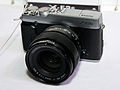
Compact EVF-only sibling of the X-Pro1 with the same 16MP X-Trans I sensor.
Verdict
Compact EVF-only sibling of the X-Pro1 with the 16.3 MP X-Trans I sensor, 1080p/24 video and 49 AF points. Discontinued, no IBIS, no touch LCD, ISO tops at 6400. A historic 350g entry into the X system.
Used-market collectors who want the first X-E body with the original X-Trans sensor.
In detail
Long ago I wrote about early Fuji bodies, and the X-E1 is one of those cameras that has real historical weight. Here is why I still find it interesting.
The X-Trans I sensor is the original. 16.3 MP on APS-C, no phase-detect AF, EXR Processor Pro doing the work. Native ISO runs 200 to 6400, modest by modern standards, and you get 49 contrast-detect AF points. None of that is fast. But the files have a certain look, and you can still pull beautiful color out of them with the film simulations.
Video is 1080p at 24 fps. That is the cap. This is a stills-first body, full stop. If you need video, look elsewhere.
Build is the entry-level Fuji recipe of its day, light, plastic-heavy, no weather sealing. No in-body stabilization, so for low light you lean on stabilized XF glass. At 350g it is light enough to live in a small sling bag without becoming a chore, and the 2.8-inch fixed LCD reminds you how far screens have come.
Battery is 350 shots CIPA, single UHS-I slot, NP-W126. Bottom line: the used market is where this camera makes the most sense now that it is discontinued.
Pros and cons
What we like
- Same 16MP X-Trans I sensor as the X-Pro1
- Compact body at just 350g
- EVF-only, simpler than the X-Pro1
- Original X-E form factor
The headline win is heritage. Same 16MP X-Trans I sensor as the X-Pro1, the camera that started the whole X system thing, and that alone makes it a collector's piece. Film simulation count is 5, the older lineup, but PROVIA, Velvia, ASTIA, PRO Neg. Std, and Monochrome cover the essentials. At 350g the body feels like a tool, not a brick.
Trade-offs
- Discontinued, 1080p/24 video only
- 49 AF points, no IBIS, small 2.8-inch LCD
The honest trade-off is the AF. 49 contrast-detect points with no phase detection means this is not an action camera. No in-body stabilization means relying on stabilized lenses for low light, and the older XF glass handles most cases. The 2.8-inch fixed LCD is small, no touch, no articulation. 1080p/24 video is genuinely the cap. Single card slot, fine until it isn't. Also, parts and service for a 2012 body is something to think about.
Who is this for
Used-market collectors who want the first X-E body with the original X-Trans sensor. Light enough to make a great second body or a daily-carry option for slow, deliberate work. Not for sports, not for video, not for anyone who needs modern AF. But for the right photographer, in 2026, it still has soul.
Is the X-E1 still worth buying in 2026?
Buy an X-E1 if you want the original one. It is the second body Fujifilm ever made for X mount, it carries the X-Trans I sensor from the X-Pro1, and it does that in a 350 gram package with a proper viewfinder. Files from this sensor look different from everything Fuji shipped afterwards, and a lot of people go looking for that specifically.
As a camera to actually work with in 2026, it asks a lot of you. Autofocus is contrast-detect only and it hunts. Burst is 6 fps. Video is 1080p at 24 frames a second and you should ignore it. The rear screen is 2.8 inches, it does not tilt, and it is not a touchscreen. ISO tops out at 6400.
So it suits one kind of shooting. A prime lens, static subjects, manual or single-point focus, and no hurry. Used that way it is a lovely thing. Used any other way it will frustrate you within a week.
If you want the X-Trans I look with the focusing fixed, the X-E2 is the same body one generation on and costs very little more. If you want the look with an optical finder, that is the X-Pro1. Check the shutter and the battery door on anything this old, and buy spare NP-W126 batteries, because the originals are finished.
X-E1 release date and lifecycle
The Fujifilm X-E1 was announced in September 2012. It was replaced by the X-E2.
| Announced | |
|---|---|
| Launch price | 999 USD |
| Status | Discontinued |
| Replaced by | X-E2 |
Announcement month is from Fujifilm’s launch announcement; the on-sale month is not recorded for this body. Launch price is MSRP at release, not a used-market price.
Full specifications
| Release year | 2012 |
|---|---|
| Launch price | 999 USD |
| Status | Discontinued |
| Megapixels | 16.3 MP |
| Sensor generation | X-Trans I |
| Processor | EXR Processor Pro |
| ISO range | 200–6400 |
| AF points | 49 |
| Subject detection | none |
| Burst (fps) | 6 |
| Max video | 1080p 24p |
| Codec | H.264 |
| Log profile | No |
| Stabilization | None |
| Viewfinder | EVF (2.36M dot) |
| LCD | 2.8" fixed |
| Weather sealed | No |
| Weight | 350g |
| Card slots | 1 |
| Card types | SD UHS-I |
| Battery | NP-W126 |
| Battery life (CIPA) | 350 shots |
| Film sims | 5 |
Highlighted rows are class-leading within the current Fujifilm APS-C lineup.
Film simulations (5)
- PROVIA
- Velvia
- ASTIA
- PRO Neg. Std
- Monochrome
Compared with



Fujifilm X-E1 vs siblings
How the X-E1 stacks up against the closest siblings in the current Fujifilm lineup.
Fujifilm X-E1 vs X-E5
The Fujifilm X-E1 and Fujifilm X-E5 are both Fujifilm X-E bodies. The X-E5 is the newer of the two, arriving in 2025. At launch the X-E1 was 999 USD and the X-E5 1,699 USD, making the X-E1 the more affordable of the two.
Fujifilm X-E1 vs X-E4
The Fujifilm X-E1 and Fujifilm X-E4 are both Fujifilm X-E bodies. The X-E4 is the newer of the two, arriving in 2021. At launch the X-E1 was 999 USD and the X-E4 849 USD, making the X-E4 the more affordable of the two.
Where to buy
The link below runs an Amazon search for this camera rather than pointing at one listing, because stock and sellers move around. As an Amazon Associate we earn from qualifying purchases — at no extra cost to you.

See it in the wild
Owner impressions and real-world photos from the Fuji community.

