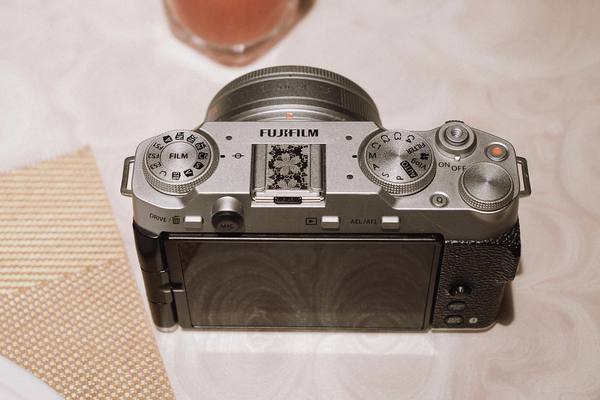
The Fujifilm X-E5 and Fujifilm X-M5 are Fujifilm APS-C bodies from different lines — the X-E and the X-M. The X-E5 is the newer of the two, arriving in 2025. At launch the X-E5 was 1,699 USD and the X-M5 799 USD, making the X-M5 the more affordable of the two.
On paper the X-E5 is the stronger body of the two. It gives you 40.2 MP of resolution, 7-stop in-body stabilization, and a 2.36M-dot electronic viewfinder.
The X-M5 isn't far behind. It hits back with 330-shot battery life and a lighter 355g body.
So which one? If you want 40.2 MP of resolution, get the X-E5. If 330-shot battery life is closer to what you actually need, the X-M5 is the smarter buy. And the X-M5 costs less — 799 USD at launch.
Where the X-E5 wins
+40.2 MP of resolution
+7-stop in-body stabilization
+a 2.36M-dot electronic viewfinder
Where the X-M5 wins
+330-shot battery life
+a lighter 355g body
Who should buy the X-E5 or X-M5?
Buy the X-E5 if…
Pick the X-E5 if 40.2 MP of resolution, 7-stop in-body stabilization matters to you. It is the better fit for buyers who already lean toward X-E handling. Read the full X-E5 review for the use-case-specific pros and cons.
Buy the X-M5 if…
Pick the X-M5 if 330-shot battery life, a lighter 355g body matters to you. It also launched cheaper at 799 USD. It is the better fit for buyers who already lean toward X-M handling. Read the full X-M5 review for the use-case-specific pros and cons.
X-E5 vs X-M5: pros and cons
Fujifilm X-E5
Fujifilm X-M5
+First X-E with 7-stop IBIS
+40MP X-Trans V with AI subject detection
+Film simulation dial, REALA ACE included
+6K/30p with F-Log2
+Cheapest Fujifilm that shoots 6K, at 799 USD
+Same AI subject tracking as cameras twice the price
+Screen turns to face you, three microphones built in
These two get compared because Fuji gave its cheapest body the same brain as one of its most expensive. Both run the X-Processor 5. Both have the AI subject detection over 425 points that finds people, animals, birds, cars and planes on its own. Both shoot 6K at 30p with F-Log2, both burst at 8 fps, both carry the film simulation dial with REALA ACE, and both run the small NP-W126S battery into a single card slot. Neither is weather sealed.
So the autofocus is not a reason to pay more. What the extra $900 buys is everything around the brain.
The viewfinder is the whole $900 question
The X-E5 has a 2.36M-dot EVF in the top corner, rangefinder style. The X-M5 has no viewfinder at all. You hold it out in front of you and compose on the screen, the way a phone taught all of us.
That sounds like a small difference until you are outside in hard sun. Composing on a screen in bright light is hard work. You tilt the camera to kill the glare, you squint, and turning the brightness up only helps a little. If you have never once pressed a camera to your eye, you will not miss it. If you have, you will miss it every sunny day.
40 MP against 26 MP
The X-E5 has the 40.2 MP X-Trans V sensor. The X-M5 has the 26.1 MP X-Trans IV, the same chip that ran the X100V and the X-T4. Those cameras make lovely pictures, and on a phone screen or an ordinary print you will not see the gap.
Where you will see it is cropping. With 40 MP, a 23mm lens can be cut down to a tighter frame and still hold up, which is half the reason people put small primes on an X-E body. On the X-M5, you crop less and choose your lens more carefully.
Stabilisation, and the small lenses people buy these for
The X-E5 has 7 stops of in-body stabilisation. The X-M5 has none. This matters more than it looks, because both bodies get bought for small, cheap, unstabilised primes like the 23mm and 27mm pancakes and the manual Voigtländers. On the X-E5 those lenses work indoors and at dusk at slow shutter speeds. On the X-M5 you need a faster shutter, a stabilised lens, or the digital stabiliser, which crops the video frame by about 1.32 to 1.44 times.
I shoot my X-E5 with the 23mm f/2.8 pancake on it. The IBIS is the reason that tiny lens is usable after the sun goes down.
Video: the X-M5 is the better camera for filming yourself
Here the cheaper body wins. The X-M5's screen swings out to face you, it has three microphones built in with a wind filter, a 3.5mm socket for a better one, and a tall mode for phone-shaped video. Its 6.2K open gate records the whole sensor, so one take gives you a wide cut and a tall cut.
The X-E5's screen tilts up and down but never faces you, so it is a camera you point at things, not at yourself. What it has instead is IBIS for walking shots and a faster SD UHS-II slot against the X-M5's UHS-I. If you film other people and places, the X-E5 is steadier. If you film yourself, buy the X-M5 and do not look back.
Build and size
The X-E5's top plate is machined from a single block of aluminium, and it feels like a small, serious camera. The X-M5 is plastic where you would rather have metal, but it is 355g against 445g, the smallest body Fuji makes with a lens mount. With a pancake on either one, both fit in a jacket pocket. My X-E5 with the 23mm pancake on it is about 535g and it disappears into my jacket, so the X-M5 is not winning on pocketability by as much as the spec sheet suggests.
Which one to buy
Settle the viewfinder question first, because it decides most of this. If you hold a camera at arm's length and look at the screen, or you film yourself, buy the X-M5 and spend the $900 you saved on a good lens. That is the better camera for you, not the compromise.
If you press a camera to your eye, shoot in bright sun, or want small unstabilised primes to work indoors, buy the X-E5. The finder, the IBIS and the 40 MP are three separate reasons, and you are paying for all three.
There is a middle answer too. The X-T30 III at $999 has the same processor and a viewfinder, without the X-E5's IBIS or 40 MP. If the viewfinder is the only thing pulling you toward the X-E5, look there first.
Highlighted cells are best in class between these two. Specs sourced from public Fujifilm product pages.
In-depth reviews
For the full long-form review of each camera, see the Fujifilm X-E5 review and the Fujifilm X-M5 review. Each one carries the full spec breakdown, pros and cons, and where this body sits in the current Fujifilm lineup.
The GR does one thing nothing else does, and it is not what you think. Where the X-M5 plus a pancake matches it, where it does not, and which of the four small lenses to buy.