X-E · 2025 · In production
Fujifilm X-E5 review
Launch price 1,699 USD · 40.2 MP X-Trans V sensor · 6K 30p video
Also written XE5 or X E5.

First X-E with IBIS and a film-simulation dial, paired with the 40MP X-Trans V sensor.
Verdict
First X-E body to add in-body stabilization (7 stops) and a film simulation dial, paired with the 40.2 MP X-Trans V sensor and X-Processor 5 AI subject detection. Records 6K/30p with F-Log2. At 1699 USD, single SD UHS-II and not weather sealed.
Rangefinder-style photographers who want 40 MP and IBIS in the X-E form factor.
In detail
Photographers tend to pick it up for Fuji's 5th generation X-Trans sensor and the price point it launched at. Released in 2025 at 1,699 USD, the body is still in production. It sits in the X-E line, Fuji's compact rangefinder-style line, lighter on the wallet than the X-Pro.
Color rendering is the classic Fuji recipe, with a bit more resolution or speed on tap depending on the sensor generation. At 40.2 MP, native ISO runs ISO 125 to 12800, and the files give you enough room to crop without falling apart. Subject detection uses the latest AI subject detection, which covers people, animals, cars, planes, and a few other categories. It just works. Burst at 8 fps is plenty for travel, family, and most outdoor work.
Video specs are more than capable for short-form and travel work. 6K 30p is on the menu, useful for cropping or downsampling to 4K.
In the hand it feels like a Fuji, with the usual tight dials and a deep enough grip. IBIS is rated at 7 stops by CIPA, which translates to hand-holding longer lenses at surprisingly slow shutter speeds. At 445g it sits in the comfortable middle, light enough for travel but solid in the hand.
Battery life is 310 shots CIPA. Carrying a spare NP-W126S is not optional. There is a single card slot (SD UHS-II), which is fine for most people but worth knowing if you shoot events that demand redundancy. Bottom line: this is the X-E body to look at if you want rangefinder style in a small, affordable body without jumping to a flagship.
Pros and cons
What we like
- First X-E with 7-stop IBIS
- 40MP X-Trans V with AI subject detection
- Film simulation dial, REALA ACE included
- 6K/30p with F-Log2
The headline win is being the first X-E with 7-stop IBIS, paired with a film simulation dial that finally puts REALA ACE at your fingertips. Film simulation count is 9, the older but still solid lineup. Out of camera, the X-Trans color science is hard to beat, and the JPEG recipes that have built up around the system are a real reason to choose Fuji over a Sony or Canon in this price band. The IBIS is the kind of feature you stop noticing until you go back to a body without it. On the video side, 6K 30p is more than enough for most hybrid shooters, and the Fuji film simulations translate to video just as well.
Trade-offs
- Single SD UHS-II slot, not weather sealed
- NP-W126S battery, 310 shots CIPA
The honest trade-off is the single SD UHS-II slot, not weather sealed. The EVF at 2.36 million dots is on the lower-resolution side by current standards, and the tilting LCD does not flip forward for vlogging. The 310-shot battery is also on the lean side for a full day out. Single card slot means backup discipline is on you, and the lack of weather sealing rules out serious rain and dust work.
Who is this for
Rangefinder-style photographers who want 40 MP and IBIS in the X-E form factor. Landscape and studio shooters who crop a lot will appreciate the resolution headroom. Travel videographers and YouTubers running a one-person crew can absolutely get by with this body. Light enough that it makes a great second body or a daily-carry option.
Image quality
40.2 MP X-Trans V and X-Processor 5, the same sensor Fujifilm puts in the X-T5 and the X-H2, in a body that weighs 445g. Native ISO starts at 125 and runs to 12800, and the extra resolution over the 26 MP generation buys you two things: prints that hold up big, and the freedom to crop a 40 MP frame down to something like an 85mm view and still have a file worth keeping.
The catch nobody mentions in the spec comparison is that 40 MP asks more of your lenses than 26 MP did. Morten Byskov put it bluntly in his review — the files can come out mushy, and the sensor only makes sense paired with the newer glass. On a Fujicron prime or one of the recent LM WR designs the difference is obvious. On an older kit zoom you are paying for resolution the lens cannot deliver.
Nine film simulations, and this is the first X-E with REALA ACE and Nostalgic Neg. on board. If you shoot JPEG — and on a Fujifilm body a lot of people do — that is a bigger practical upgrade than the megapixels.
ISO behaviour is what X-Trans V does everywhere. Clean to 3200, usable at 6400, and 12800 when the alternative is not getting the shot. Denser pixels mean the per-pixel noise is higher than the 26 MP bodies, but downsampled to any sane output size the difference disappears.
Photos shot on the X-E5
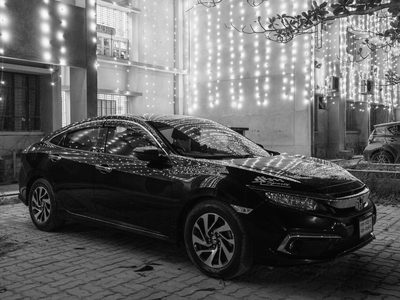
We shot and published 3 frames on the X-E5, November 2025 to May 2026. Click any thumbnail for the full-size file and its settings on masnun.photos. These are edited photographs, not resolution tests — read them as a record of what the camera actually gets used for.


Autofocus in practice
X-Processor 5 brings the deep-learning subject detection to the X-E line for the first time: people, animals, birds, cars, motorcycles, aircraft and trains, plus face and eye detection that actually holds through a turned head. For X-E4 owners this is the upgrade. The most common complaint about the old body was that it was the camera you reached for when you wanted quick, dependable autofocus and it was not quite that, and this generation fixes it.
It is not a sports camera and does not claim to be. Mechanical burst tops out at 8 fps, so the limit you hit first is the frame rate, not the tracking. For street, travel, family and portraits the AF is now a solved problem rather than something you plan around.
The dissenting voice is worth hearing. Robin Wong found the autofocus underwhelming enough that Fstoppers ran the review under the headline that this is a beautiful but flawed camera, comparing it unfavourably with much older bodies. My read is that this is a comparison against phase-detect systems built for tracking rather than a fault in the X-E5, but if continuous AF on erratic subjects is the job, the X-H2S exists for a reason.
The joystick recentres the AF point with a tap, which sounds trivial and is the control you will use most.
Video verdict
6K at 30p with F-Log2, in H.265 or H.264, and 7 stops of IBIS underneath it. That combination is what changes the X-E line for video. Every earlier X-E asked you to bring a tripod or a stabilised lens; this one lets you walk and record.
6K also gives you a real reason to shoot above 4K rather than a spec-sheet one. Downsample to 4K and the footage is cleaner than a native 4K capture; crop into it in the edit and you have reframed a shot without losing delivery resolution.
The limits are the body, not the sensor. One SD UHS-II slot, no weather sealing, and a 310-shot battery that empties faster on video than the CIPA number suggests. The screen tilts but does not face forward, so this is a camera you point at things rather than at yourself. If you film yourself for a living, the X-S20 was built for that job and the X-E5 was not.
What makes this camera special
The film simulation dial, and the fact that Fujifilm finally built the X-E body people kept describing as a mini X-Pro.
The dial sits on the top plate with a window showing the selected simulation, and three of its positions are custom slots you can load with your own recipes. Digital Camera World called it the best implementation of the film simulation dial yet, and the reason is the three slots: on the X-T50 the dial is mostly a shortcut to sims you already had, and here it is a shortcut to your own settings.
The top plate itself is machined from a single block of aluminium, which is where a chunk of the extra 81g over the X-E4 went. Owners who have handled both agree the X-E5 feels like a more serious object. Whether that is worth double the money is the argument this camera has not stopped having since June 2025.
And the IBIS. 7 stops in a rangefinder-shaped body means the small, slow, unstabilised primes people buy X-E bodies for — the 27mm pancake, the manual Voigtländers — become usable indoors and at dusk. That is a quiet change to what the camera can do, and it is the one X-E4 owners notice first.
What X-E5 owners actually say
No recent Fujifilm body has divided its own audience like this one, and the split is almost entirely about price rather than the camera.
The X-E line used to be the cheap way into X mount. The X-E4 launched at 849 USD; the X-E5 launched at 1,699 USD. As one commenter on r/fujifilm put it, it jumped not one but two steps up in price while landing near the X-T50, and the X-E used to be close to the cheapest body in the range. That is the whole complaint, repeated in every thread, and it is a fair one — at this money the X-T5 gives you weather sealing, two card slots and a better battery for the same internals.
Handling is the second fight. One owner pre-ordered, used it for a few days and sent it back: beautiful to look at, but a sharp-edged top plate that hurt their hand, not enough of a bump front or back to hold onto, and heavier than they wanted from an X-E. Others push straight back — reviewers who complain the body does not fit their hands, one comment ran, get a camera returned and a bad review out of it while everybody else just gets on with shooting. Digital Camera World and Morten Byskov both rate the grip as clearly improved over the X-E4, so pick your reference point.
Owners who kept theirs are unusually fond of it. One swapped an X-T5 for one and does not miss the bigger viewfinder. Another calls it their favourite camera ever and singles out the shutter sound. A third bought it after nearly cancelling the order over the volume of complaints, and thinks the complaint volume is misleading people who only want to know what the camera is like.
Two things to know before you buy. Fujifilm published a service notice on November 20, 2025 confirming that the strap lugs can loosen and the strap can come off the body — fewer than 0.1% of units shipped, with free inspection and repair, and owners on r/fujifilm reacted about as you would expect. And the new XF 23mm F2.8 R WR pancake that ships in the kit runs a focus calibration cycle every time you power the camera on or off or switch to playback, which adds seconds to a workflow that was instant on an X-E4.
Rating breakdown
| Dimension | Score |
|---|---|
| Image quality | 9 / 10 |
| Autofocus | 8 / 10 |
| Video | 7 / 10 |
| Handling | 7 / 10 |
| Value | 6 / 10 |
Sub-ratings are the author’s assessment of each dimension against the current Fujifilm APS-C lineup.
X-E5 release date and lifecycle
The Fujifilm X-E5 was announced in June 2025.
| Announced | |
|---|---|
| Launch price | 1,699 USD |
| Status | Still in production |
| Replaced | X-E4 |
Announcement month is from Fujifilm’s launch announcement; the on-sale month is not recorded for this body. Launch price is MSRP at release, not a used-market price.
Full specifications
| Release year | 2025 |
|---|---|
| Launch price | 1,699 USD |
| Status | Current |
| Megapixels | 40.2 MP |
| Sensor generation | X-Trans V |
| Processor | X-Processor 5 |
| ISO range | 125–12800 |
| AF points | 425 |
| Subject detection | ai |
| Burst (fps) | 8 |
| Max video | 6K 30p |
| Codec | H.265, H.264 |
| Log profile | F-Log2 |
| Stabilization | 7 stops |
| Viewfinder | EVF (2.36M dot) |
| LCD | 3" tilt touch |
| Weather sealed | No |
| Weight | 445g |
| Card slots | 1 |
| Card types | SD UHS-II |
| Battery | NP-W126S |
| Battery life (CIPA) | 310 shots |
| Film sims | 9 |
Highlighted rows are class-leading within the current Fujifilm APS-C lineup.
Film simulations (9)
- PROVIA
- Velvia
- ASTIA
- Classic Chrome
- REALA ACE
- Classic Neg.
- Nostalgic Neg.
- ETERNA
- ACROS
Compared with


Fujifilm X-E5 vs siblings
How the X-E5 stacks up against the closest siblings in the current Fujifilm lineup.
Fujifilm X-E5 vs X-E3
The Fujifilm X-E5 and Fujifilm X-E3 are both Fujifilm X-E bodies. The X-E5 is the newer of the two, arriving in 2025. At launch the X-E5 was 1,699 USD and the X-E3 899 USD, making the X-E3 the more affordable of the two.
Fujifilm X-E5 vs X-E2S
The Fujifilm X-E5 and Fujifilm X-E2S are both Fujifilm X-E bodies. The X-E5 is the newer of the two, arriving in 2025. At launch the X-E5 was 1,699 USD and the X-E2S 699 USD, making the X-E2S the more affordable of the two.
Fujifilm X-E5 vs X-E2
The Fujifilm X-E5 and Fujifilm X-E2 are both Fujifilm X-E bodies. The X-E5 is the newer of the two, arriving in 2025. At launch the X-E5 was 1,699 USD and the X-E2 999 USD, making the X-E2 the more affordable of the two.
Further reading
Article
The Fujifilm X-E5 as an X100VI alternative: which 23mm lens?
I owned both and kept the X-E5, for the interchangeable lenses, the film simulation dial, and the look. Two small 23mm lenses cover daylight and low light.
Article
Why I prefer Fujifilm APS-C over GFX medium format
GFX wins on resolution and dynamic range. APS-C wins on depth of field, fast glass, reach, weight, and price. Here is the full trade-off, with the numbers.
Article
Fujifilm X-E5 and the Voigtlander 27mm f/2 Ultron
565g of metal, no autofocus, a focus tab, and Fuji's peaking doing the hard part. A week of rain with the most tactile setup I own.
Article
Fujifilm X-T6 rumors: every leak scored out of 10
Announcement is the first week of September. Half the spec list going around came from a chatbot. Here is every X-T6 rumor with a likelihood score and the source it came from.
Article
How to get phone-like HDR photos from a Fujifilm camera
Your phone takes eight dark photos and averages them. Here are five ways to get the same result on a Fuji, explained from scratch with no jargon.
Article
A love letter to the Fujifilm X100 series
Bought the X100V before the hype, upgraded to the X100VI, sold it over a synthetic shutter click, and came back to a black one. Four years of my own photos.
Article
Quick Switching between Color and B&W profiles on Fuji bodies
The Nikon Zf has a B&W switch. You can build the same thing on a Fuji: FS slots on the film simulation dial, or a Recall C1 button on everything else.
Article
Fujifilm X-M5 as Ricoh GR alternative
The GR does one thing nothing else does, and it is not what you think. Where the X-M5 plus a pancake matches it, where it does not, and which of the four small lenses to buy.
Article
X100VI vs Leica Q3 and Q3 43: what the money buys
The Q3 43's 43mm f/2 is the Leica closest to the X100VI's 35mm view, and at matched framing the maths says almost two stops. Here is what the other 6,351 USD buys.
Where to buy
The link below runs an Amazon search for this camera rather than pointing at one listing, because stock and sellers move around. As an Amazon Associate we earn from qualifying purchases — at no extra cost to you.

See it in the wild
Owner impressions and real-world photos from the Fuji community.


Sources and further reading
Specs come from Fujifilm. Measured results, other reviewers’ verdicts, and owner reports are credited to the people who did the work:
- Fujifilm — X-E5 product page and specifications
- Fujifilm — service notice on X-E5 strap lugs, November 20, 2025
- DPReview — Fujifilm X-E5 in-depth review
- Digital Camera World — X-E5 review, "a return to form" (grip, build, the film simulation dial)
- Alex Cooke (Fstoppers) on Robin Wong's review — "beautiful but flawed" (autofocus, grip, price against the X-T5)
- Morten Byskov (5050 Travelog) — X-E5 review (40 MP asks more of your lenses)
- r/fujifilm — "X-E5: My experience. Some things to consider for potential buyers" (the owner who sent one back)
- r/fujifilm — "X-E5 is super fun" (the counter-argument to the review pile-on)
- r/fujifilm — "XE5 Strap Lug Issue Officially Confirmed"
- r/fujifilm — "The new 23mm f/2.8 pancake slows down your camera" (the calibration cycle on power-up and playback)
- X-E4 vs X-E5, side by side