Fujifilm XF lens · announced June 12, 2025
Fujifilm XF 23mm F2.8 R WR review
23 mm · f/2.8 · 90 g · 8 elements in 6 groups
Verdict
A 23 mm-long, 90g pancake prime for X mount with an aperture ring, weather sealing, and an 11-blade diaphragm. Introduced June 12, 2025, alongside the X-E5, and aimed squarely at photographers who want their smallest Fuji body to feel as compact as an X100.
Photographers who shoot mostly in daylight at a 35 mm-equivalent field of view and want the smallest possible native X-mount combination.
In detail
The XF 23mm F2.8 R WR is a compact interchangeable-lens prime for X mount, and the entire pitch of the lens is that you can stop noticing it is on your camera. At 23 mm long and 90g, it sits flat against the body, hides under the included LH-X27 hood, and disappears into a coat pocket with the camera attached. That is the whole point of the lens.
Fujifilm introduced it on June 12, 2025, alongside the X-E5. The lens is built around an eight-element, six-group optical formula with two aspherical elements and an 11-blade rounded diaphragm. It focuses down to 0.20 m from the sensor plane, magnifies up to 0.15×, and accepts 39 mm filters. The body is weather resistant and rated for operation down to −10 °C. A DC motor drives the focusing group, and Fujifilm positions the lens as a match for the 40.2 MP X-Trans CMOS 5 HR sensor used in the X-T5, X-H2, X-T50, X-E5, and X100VI-era bodies.
The XF 23mm F2.8 R WR is a 23 mm focal length. That is roughly a 35 mm field of view in 35 mm-format terms — the classic documentary, street, and everyday-carry focal length. It is the same angle of view Fujifilm uses in the fixed-lens X100 cameras, and the company is open that the design is meant to give X-mount bodies a similar compact character with the flexibility to swap to a different focal length when you want one.
For someone who already shoots a small Fuji body — an X-E5, X-T30 III, X-M5, or one of the older X-Txx cameras — the lens turns the camera into something close to an X100 without giving up the interchangeable mount. For someone who already owns an X100VI, it is the natural companion to a second body, because the 35 mm-equivalent view stays consistent across both.
Pros and cons
What we like
- 90g and 23 mm long — true pancake dimensions on every X body.
- Aperture ring, focus ring, and weather resistance at this size are unusual.
- 0.20 m close focus and 0.15× magnification beat the older XF 27mm F2.8 pancake.
- 11-blade rounded diaphragm keeps highlights relatively round stopped down.
- Designed to resolve for Fujifilm's 40.2 MP X-Trans CMOS 5 HR sensor.
The size is the headline. A 23 mm-long, 90g lens that still carries an aperture ring, weather sealing, a dedicated focusing ring, and an 11-blade rounded diaphragm is unusual; most pancake primes at this weight give up one or more of those. With the XF 23mm F2.8 R WR, you do not trade away the tactile Fujifilm experience to get a small lens.
The optical formula is more aggressive than the older XF 27mm F2.8's. Two aspherical elements in an eight-element, six-group design, paired with a closer 0.20 m minimum focus and a higher 0.15× reproduction ratio, are the kind of spec bumps you expect to see when a manufacturer updates a pancake. Fujifilm's positioning of the lens as compatible with the 40.2 MP X-Trans CMOS 5 HR sensor is also a vote of confidence: a lens that resolves for that sensor will not feel dated when paired with the higher-resolution bodies still to come.
In practical daylight use, the lens is small enough that the camera stops feeling like a camera. On an X-E5, the whole rig is jacket-pocketable. On an X-T5, it removes almost all of the front-heaviness that comes with larger zooms. For a photographer who walks a lot and shoots a lot, that is a real ergonomic gain, not a marketing line.
Trade-offs
- f/2.8 is one stop slower than the XF 23mm F2 R WR.
- No optical image stabilization — leans on the body's IBIS when present.
- DC motor AF is not marketed as a linear-motor design.
- Pancake rings are small and close together; not ideal with gloves.
- Hood adds bulk and slightly reduces the pancake character.
The f/2.8 maximum aperture is the obvious cost. It is one stop slower than the XF 23mm F2 R WR and two stops slower than the XF 23mm F1.4 R LM WR. That matters for low-light work, for shallow depth of field, and for separating a subject from a busy background.
The lens does not have optical image stabilization. On bodies with in-body stabilization — X-T5, X-H2, X-T50, X-E5, X-S20 — that is not a problem. On bodies without IBIS — X-T30 III, X-M5, older X-Txx models — you are relying on lens stabilization (which this lens does not have) or on your own steady hands for slow shutter speeds. In daylight, f/2.8 is fast enough that this rarely matters. In dim rooms or indoors at dusk, it can.
The autofocus motor is described in Fujifilm's documentation as a DC motor, not a linear stepping motor. That does not mean autofocus is bad, but it does mean you should not assume parity with the linear-motor XF lenses in continuous AF or silent video focusing. The marketing emphasises smoothness and consistency, which is appropriate for a pancake designed primarily for stills and considered, deliberate work.
Pancake ergonomics have tradeoffs of their own. The aperture and focus rings are necessarily small; the focus ring is electronic rather than mechanically coupled. With the LH-X27 hood fitted, the front element is no longer flat to the body, so the "pancake" character is reduced by a few millimetres. None of these are dealbreakers, but they are real, and they are inherent to the form factor.
Who is this for
The XF 23mm F2.8 R WR is the lens to buy if compactness is a feature you actively want, not a feature you merely tolerate. If you carry a small Fuji body and you want the camera-plus-lens rig to feel like a fixed-lens compact, this lens is built for that brief. If you shoot mostly in daylight, travel a lot, or document life around you at a 35 mm-equivalent field of view, the tradeoffs shrink and the size advantage grows.
It is a less obvious fit if most of your work is indoors, at night, or with heavy subject isolation. For those use cases, the XF 23mm F2 R WR or the XF 23mm F1.4 R LM WR is a better answer. The XF 23mm F2.8 R WR also does not replace a fast prime for video shooters who need silent, linear-motor continuous AF.
If you already own an XF 27mm F2.8 R WR and shoot mostly at that focal length, the upgrade question is mostly about 4 mm of field of view and an updated optical formula. That is a real difference, but it is not the kind of difference that justifies owning both unless you shoot both focal lengths regularly.
Photos shot on the XF 23mm F2.8 R WR
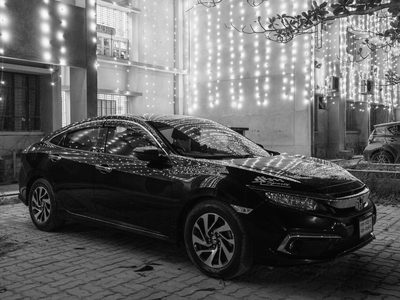
We shot and published 3 frames on the XF 23mm F2.8 R WR, November 2025 to April 2026. Click any thumbnail for the full-size file and its settings on masnun.photos. Every frame is edited, so read them as a record of how the lens renders in use rather than as a resolution test.


Full specifications
| Focal length | 23 mm |
|---|---|
| 35mm equivalent | 35 mm |
| Maximum aperture | f/2.8 |
| Minimum aperture | f/16 |
| Optical construction | 8 elements in 6 groups |
| Special elements | 2 aspherical elements |
| Min. focus distance | 0.20 m |
| Max. magnification | 0.15× |
| Aperture blades | 11 |
| Filter thread | 39 mm |
| Diameter × length | 61.8 × 23 mm |
| Weight | 90g |
| Weather sealing | Yes |
| Min. operating temp | -10 °C |
| Focus drive | DC motor |
| Optical stabilization | No |
| Announced | June 12, 2025 |
Rating breakdown
| Dimension | Score |
|---|---|
| Image quality | 8 / 10 |
| Autofocus | 7 / 10 |
| Handling | 9 / 10 |
| Value | 7 / 10 |
Where to buy
The link below runs an Amazon search for this lens rather than pointing at one listing, because stock and sellers move around. As an Amazon Associate we earn from qualifying purchases — at no extra cost to you.
XF 23mm F2.8 R WRAmazon · search resultsCompare head-to-head
Still choosing?
If you are weighing this against the other small primes, the lens picker ranks them against how you actually shoot. If the body is still open too, start with the camera quiz.