Fujifilm X-E5 and the Voigtlander 27mm f/2 Ultron
Shooting the manual-focus Voigtlander 27mm f/2 Ultron on the Fujifilm X-E5: focus peaking, the focus tab, front lever setup, and a week of sample photos.
By Abu Ashraf Masnun ·
It rained for most of last week, the kind of warm monsoon rain that never really stops, and I ended up sitting in a parked car with a camera in my hand and nothing to shoot but wet tiles and street lamps. The camera was the Fujifilm X-E5. On the front of it was the Voigtlander Ultron 27mm f/2, a fully manual lens with no autofocus motor, no fly-by-wire ring, and a little focus tab you push with one finger. I have shot Fuji for years, mostly with autofocus glass. This combination made me slow down more than anything I have used, and I came home with more keepers than I expected.
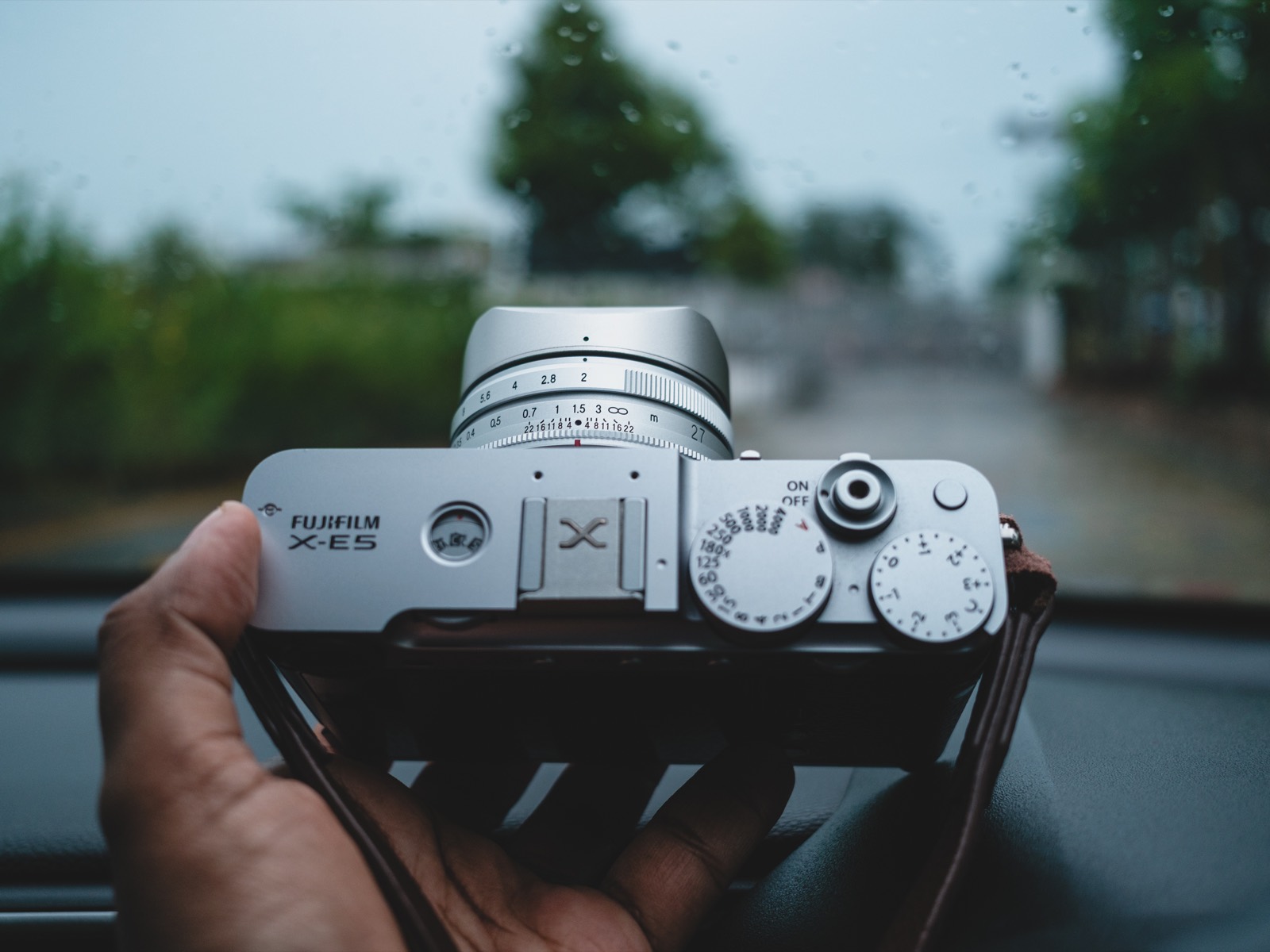
This is not a lab review. I have no MTF charts for you. This is what it is like to actually carry the X-E5 and the Voigtlander 27mm together, why Fuji's focus peaking makes the manual focus part almost trivial, how I set up the front lever so my finger does the work, and what the files look like after a week of rain.
What the lens actually is
The Voigtlander 27mm f/2 Ultron X is a native X-mount lens, not an adapted rangefinder lens. Cosina built it specifically for the Fuji APS-C sensor. Cosina's first lens for X mount was the Nokton 35mm f/1.2 in 2021, and the Ultron follows the same recipe of all metal and manual focus only. It is 120g, about 23.5mm long from the mount, takes 43mm filters, opens to f/2, closes to f/22 in one-third stops, and focuses down to 25cm. Ten aperture blades, six elements in four groups, all metal, made in Japan. On APS-C the 27mm gives you a 40mm equivalent view, which sits right between the 35mm street look and the 50mm normal look. It costs about $600. I have written a full review of the lens with sample photos and the measured optical detail if you want the longer version.
It has no autofocus and it never will. What it does have is electronic contacts, so the camera knows the lens is there and writes the settings into your files. I checked the EXIF on the photos in this article and they all carry the aperture I set on the ring, f/2 and f/5.6 and f/8, along with the lens name. That sounds like a detail until you are six months down the line trying to remember what you shot something at.
"The entirely metal construction has a reassuring heft in the hand, and the focus ring is as smooth as a buttered jellyfish with just enough resistance for precise and accurate control."
Focus peaking is why this is easy, not hard
The thing people worry about with a manual lens is missing focus. On the X-E5 I miss less than I expected, and the reason is that Fuji gives you a whole shelf of manual focus aids. Set the focus mode selector to M, then go to AF/MF SETTING and MF ASSIST, and you get a choice of tools. You can also hold the centre of the rear command dial to bring the same menu up without digging through the menus at all.
- FOCUS PEAK HIGHLIGHT, which lights up the high-contrast edges that are sharp. You pick the colour and the peaking level. This is the one I use.
- DIGITAL SPLIT IMAGE, a split rectangle in the middle of the frame, in colour or black and white, that lines up when focus is right. It is the old rangefinder patch, simulated.
- DIGITAL MICROPRISM, a grid that shimmers when you are out and clears when you are in.
- FOCUS METER, a needle under the focus point that swings left when you are focused in front of the subject and right when you are behind it.
- FOCUS MAP, which paints little squares green where you are in focus, yellow in front, blue behind.
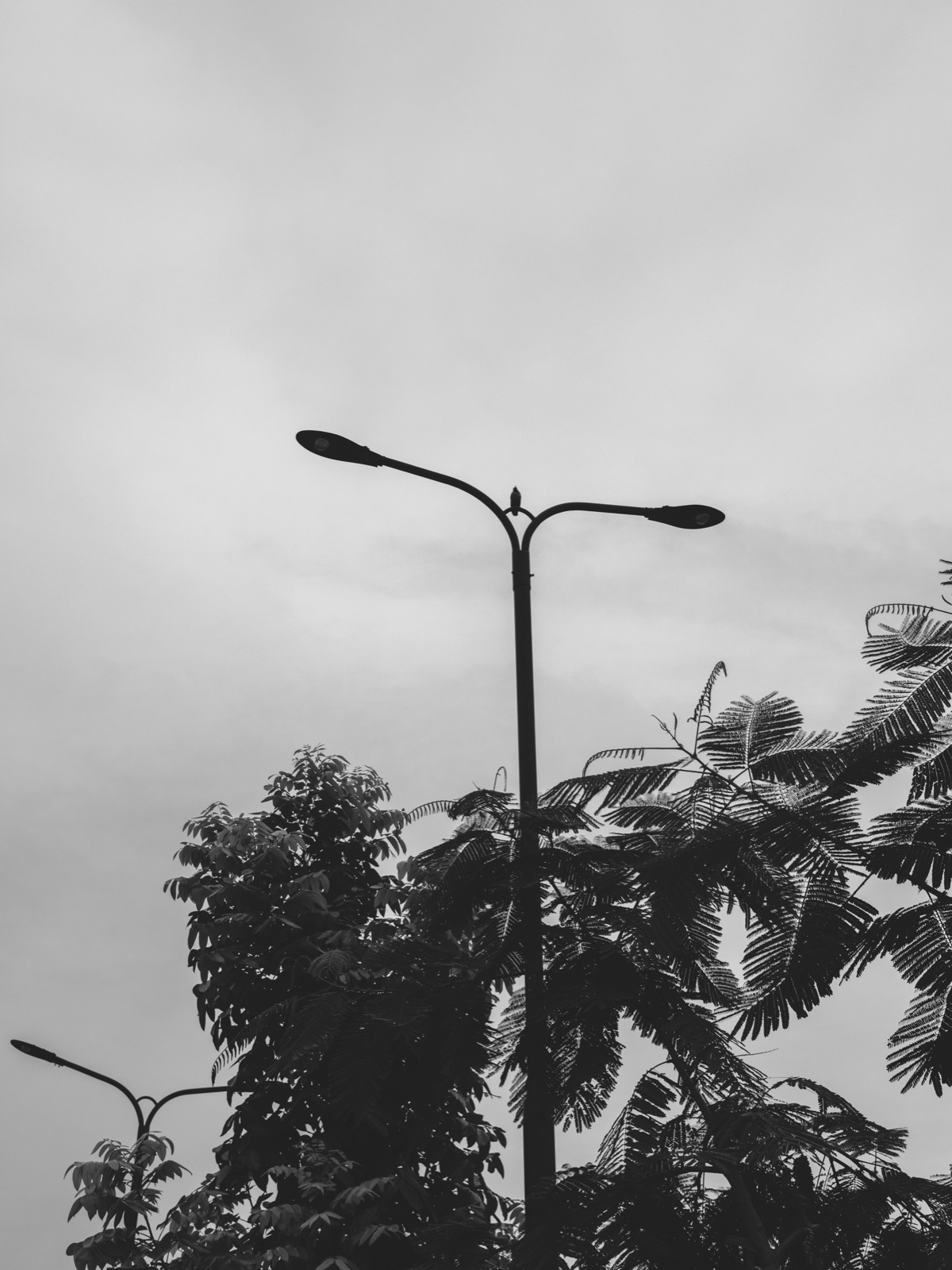
Peaking is the one that works with this lens, and it works because of what the lens does optically. The Ultron snaps. Wide open at f/2 the plane of focus is thin and the edges go from mush to hard very suddenly, so the peaking dots do not smear across half the frame the way they do with a soft old adapted lens. You turn the tab, the highlights crawl across the subject, they light up, you stop. In the black-and-white lamp photo below I was at f/2 against a bright white sky, and the peaking put me on the metal edges in a moment. I still punched in to confirm before I pressed the shutter, because at f/2 the margin is thin, but peaking did the finding and focus check only had to agree with it.
Two settings make it much better. Turn on INTERLOCK MF ASSIST & FOCUS RING, and the peaking only appears while you are actually turning the ring, so your viewfinder is clean the rest of the time. Then turn FOCUS CHECK on, and the camera punches in automatically the moment you touch the ring, and you press the centre of the rear dial to come back out. Peaking gets you to roughly right, focus check confirms it, and neither one costs you a button press.
"I wouldn't have thought the 2.36m-Dot 0.62x OLED on the Fujifilm X-E5 would be any good for manual focusing, but it's proved better than I expected."
One more thing that quietly helps. The X-E5 has in-body stabilisation, rated at up to 7 stops. A manual lens has no optical stabiliser of its own, so on most bodies you are hand-holding naked. Here the sensor is still fighting for you while you turn the ring, and at dusk that is the difference between a sharp frame at 1/15s and a soft one.

The focus tab is the reason it is fun
A focus tab is a small ridged lug sticking out of the focus ring. Instead of gripping the barrel and rotating it like a zoom, you put one fingertip on the tab and push. That is the whole idea, and it changes how the camera feels in a way I did not expect. The throw is short, so infinity to about a metre is one small sweep. After a few days my finger knew where the tab sat for arm's length, for across the road, for infinity, and I stopped looking at the barrel. Voigtlander made this the first of their X-mount lenses to get a tab, and the distance scale actually stops dead at infinity instead of turning past it, which matters when you are focusing by feel in the dark.
The tab is also what makes zone focusing practical. Set f/8, put the tab where the depth-of-field marks cover from two metres to infinity, and the lens is done. Now you are just framing. Fuji even lets you choose how honest the camera's own depth-of-field display is: in AF/MF SETTING there is a DEPTH-OF-FIELD SCALE option with FILM FORMAT BASIS for prints and PIXEL BASIS for pictures you will pixel-peep on a screen. Pick PIXEL BASIS and the camera gives you a much tighter, more pessimistic zone. I leave it there, because I would rather be told the truth.
"After using it for 3 days; I could happily boast that my manual focusing skill have indeed improved. Maybe I enjoy using the focusing tab on this lens."
I am not going to pretend the tab is perfect. It is a small claw with ridges on it, and Tudor Mateescu, who otherwise loves the lens, says it plainly.
"The tiger focusing tab is doing the job very well because it has some idents so it's not very slippery. I would have preferred a normal focusing tab."
My own hands disagree slightly, and so do other owners, because of where the tab sits on the barrel. It is low enough that it falls under my finger whether I am holding the camera flat or turned on its side, which is the part I care about with a rangefinder-shaped body.
"The tab is positioned on the bottom half of the lens, which makes it easy to reach when shooting vertically and horizontally."

Set the front lever up for manual focus
The X-E5 has a small lever on the front, under your right index finger, and it is the most underused control on the camera. You pull it toward the grip or toward the lens, and each direction has a short pull and a long pull, so it is four functions in one tiny switch. From the factory they are set to this:
- Pull toward the grip: SURROUND VIEW
- Pull and hold toward the grip: ASPECT RATIO
- Pull toward the lens: DIGITAL TELE-CONV.
- Pull and hold toward the lens: FS RECIPE
You change them by holding DISP/BACK to open the function setting screen, or through BUTTON/DIAL SETTING and FUNCTION (Fn) SETTING in the menu. Fuji lets you drop almost anything on there, including several things that only matter on a manual lens. Here is the layout I settled on for shooting the Voigtlander:
- Pull toward the grip: MF ASSIST ON/OFF. Peaking on when I want it, gone when I want a clean frame. This is the one I use most, because peaking on a busy street can be visual noise.
- Pull and hold toward the grip: FOCUS CHECK LOCK. Punch in to confirm critical focus at f/2 and keep the magnified view locked while I recompose, without hunting for the rear dial.
- Pull toward the lens: SURROUND VIEW. Leave the default. It greys out the area outside your frame instead of hiding it, so you see the person about to walk into the picture. It is the closest thing the X-E5 has to looking through a rangefinder window, and it pairs beautifully with a manual lens.
- Pull and hold toward the lens: DIGITAL TELE-CONV. The 1.4x and 2x crops turn a 40mm-equivalent view into roughly 58mm and 81mm. On a prime you cannot zoom, this is a genuinely useful cheat when you cannot take three steps forward.
If that mix does not suit you, a few other assignments earn their place with a manual lens:
- NATURAL LIVE VIEW, which strips the film simulation out of the viewfinder and shows you a flat, natural image. Useful when a heavy look is hiding shadow detail you are trying to focus on.
- HISTOGRAM, because you are already setting shutter speed and aperture by hand, and the histogram is the one thing the camera can still tell you that the dials cannot.
- FILM SIMULATION or FS RECIPE, if you would rather drive looks from your finger than from the dial.
- ELECTRONIC LEVEL SWITCH, which I want more than I would like to admit when I am shooting architecture with no autofocus to distract me.
- ISO, which is a fair choice on this camera since the shutter speed and aperture already live on physical dials and ISO does not.
The film simulation window
The X-E5's top plate has a film simulation dial with a little window in it that shows you the name of the look you are on. Six marked positions, PROVIA, VELVIA, ASTIA, CLASSIC CHROME, REALA ACE and ACROS, plus FS1, FS2 and FS3 for your own recipes and a C position. Fuji could have made this a menu item. Instead they made it a mechanical dial with a physical readout, and on a fully manual setup it completes the picture. Shutter speed on a dial, exposure compensation on a dial, aperture on a lens ring, distance on a scale, and now the look on a dial too. The camera is off. You can still read what it is going to do.
It also changed my habits. I shot the black-and-white frames in this article on ACROS, because turning a dial takes half a second and digging into a menu takes long enough that I would not have bothered. Deciding on black and white while I am standing there changes what I point the camera at, which is the real argument for the dial. Everything here went through Lightroom afterwards, so these are not straight-out-of-camera JPEGs, but the look was chosen at the moment of the shot rather than a week later on a laptop.
What the files look like
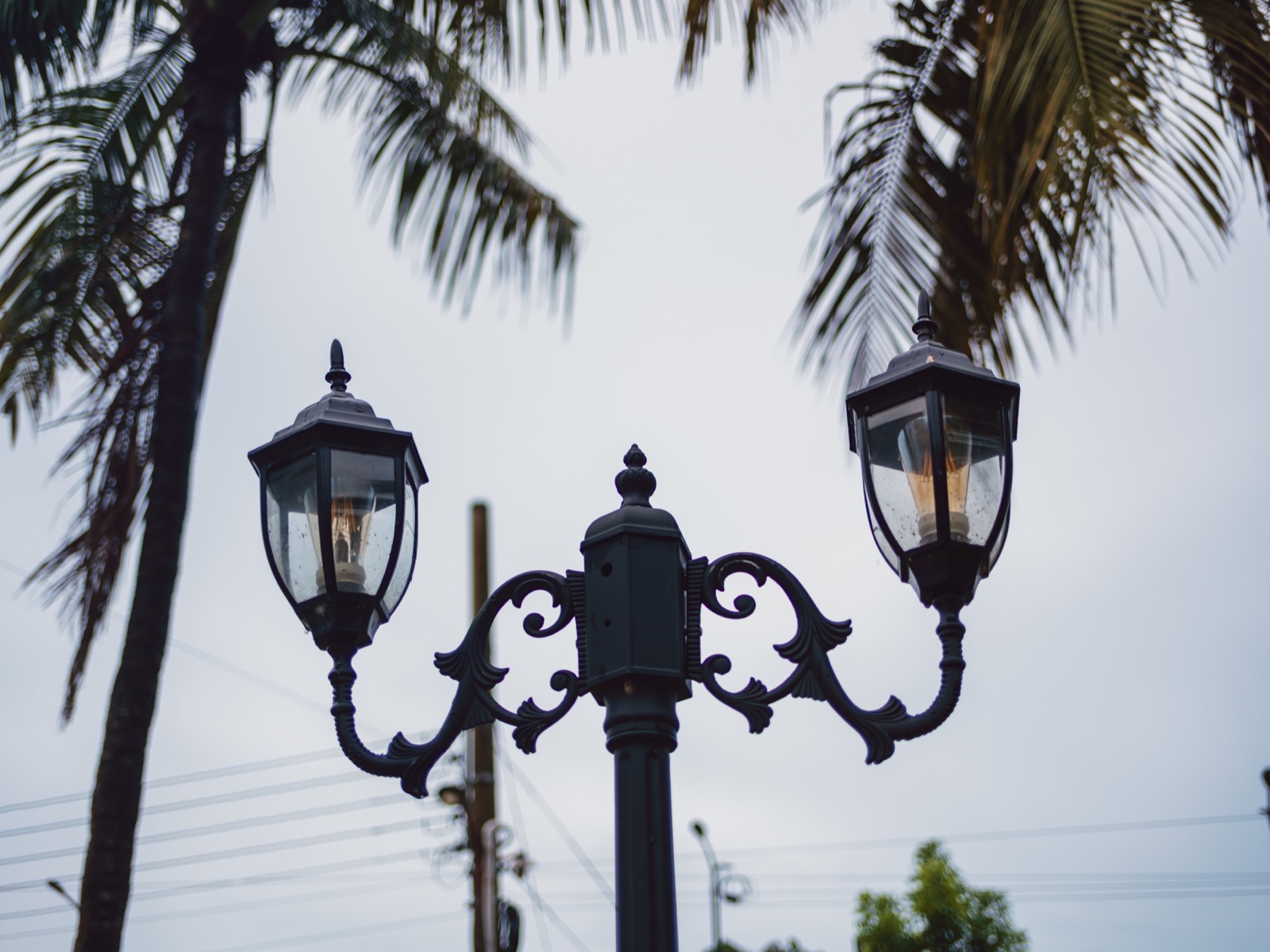
Sharp at f/2, in the middle and most of the way out. I keep waiting to find the aperture where this lens gets good, and it is just open. What I like more than the sharpness is the way it falls off. Focus is hard, out of focus is soft and round, and the transition between them is short. It draws with more character than the Fuji f/2 primes I own, which are clean and slightly clinical by comparison.
The other people who have lived with it describe the same two things, the sharpness and the way it renders.
"Sharpness is very good and it's everywhere. 3D pop all over from F2 to F16."
"The vignette, softness, and contrast give the rendering a film-like look. At f/2.0 the background separation is substantial and focus fall off is butter smooth."
The 25cm minimum focus is the spec I use most and thought about least before buying. A 40mm-equivalent lens that focuses that close is a half-macro when you want it to be. The wet flower below is f/2 at 25cm-ish, hand-held, and the background is completely gone. Morten Byskov put the colour side of it well, that these lenses have a warm tone that is not too clinical, and that is what I see in the greens here.

It stays genuinely small
The X-E5 body is 445g. The lens is 120g. That is 565g for the whole camera, and the lens sticks out about 23.5mm, so the thing still slides into a jacket pocket if the jacket is honest about being a jacket. For comparison, Fuji's own XF 27mm f/2.8 R WR pancake is 84g and shorter, so the Voigtlander is not the smallest 27mm you can buy, but it is a stop faster, it is all metal, and it does not have a plastic barrel that creaks.
Small matters more with a manual lens than with an autofocus one, and this took me a while to work out. A manual lens asks you to be there, hands on the camera, deciding. If the kit is heavy you leave it at home and there is nothing to decide. At 565g I take it everywhere, which is how I ended up making photographs of street lamps from a parked car in the rain instead of doing nothing.
The square hood in the first photo is not a Voigtlander part. It is an aftermarket 43mm screw-in square metal hood, and I put it on for two reasons. A square hood shades a rectangular sensor more sensibly than a round one does, and it looks the way I want the camera to look. The second reason is the real one and I am not going to dress it up.
One opinion, since people always ask
I have never owned a Leica M, and I have never even held one, so take this lightly. What M owners describe wanting from theirs is a flat metal box, an aperture ring, a distance scale, and a rhythm where you set the camera first and then wait for the picture. That is what this setup feels like to me, for about $2,300 all in. Jay Massie called the Voigtlander on a Fuji what people were hoping the X100 line would feel like, and that is roughly where I land too.
It is not an M. No rangefinder patch, no coupled cam, no optical window, and the resale value is not going to be kind to you either. Buy it because the lens is genuinely good and the way it makes you work suits you, not because of what it resembles on a shelf. If you want the longer version of the Leica comparison from someone who actually shoots both, Jörg-Peter Rau wrote a fair one at Macfilos.
The honest downsides
- There is no autofocus, and there never will be. Kids, dogs and anything moving fast are a different game. I do not carry an autofocus lens as a backup, I zone focus and accept that I will miss some frames. That has to be a trade you are actually fine with. To be fair, my finger got quick on the tab faster than I expected, and I miss far less now than I did in the first few days.
- The tab is a small claw rather than a full crescent, and if your hands are cold or wet your finger can slip off it.
- The nice square hoods for it screw in rather than bayonet on, so you cannot snap one on and off in a hurry.
- At $600 it costs more than several very good autofocus lenses for the mount, including Fuji’s own 27mm pancake and the Viltrox 27mm.
- The X-E5 has no built-in flash, which you feel indoors once the light drops and you are already working at f/2.

None of that has made me take it off. If you buy one, my advice is to put it on the X-E5 and leave it there for a month before you go back to an autofocus lens. The first week is clumsy. The second week your finger already knows where the tab goes, and by then you are choosing your focus point on purpose instead of correcting whatever the camera picked.
What other people say
I am one person with one copy of the lens, so read the people who have shot it longer. These are the reviews and write-ups I found genuinely useful while I was deciding:
- Jay Massie — Voigtländer Ultron 27mm f/2 Fuji-X mount review
- Morten Byskov (5050 Travelog) — the X-E5 with Voigtländer manual focus lenses
- Morten Byskov (5050 Travelog) — Voigtländer Ultron 27mm f/2 X review
- Tudor Mateescu — Voigtländer Ultron 27mm f/2 X review
- Ivan Loh (FujiFanBoys) — "Voigtlander 27mm F2, something special"
- Michael (I Like Calculus) — "My favorite pancake lens"
- Feroz Khan (The Phoblographer) — why the Voigtlander 27mm f/2 is such an exciting lens
- Joy Celine Asto (Photofocus) — the Fujifilm street photographer’s dream lens?
- Jörg-Peter Rau (Macfilos) — is the Fujifilm X-E5 a Leica alternative?
- Voigtländer — official 27mm f/2 Ultron X specifications
Where to buy
These are Amazon links and I earn a small commission if you buy through them, at no extra cost to you. It is a nice way to support the site.
- Fujifilm X-E5445g, 40MP, IBIS, film simulation dial, and the front lever this article is half about.
- Voigtlander Ultron 27mm f/2 (Fujifilm X)120g of metal, focus tab, 25cm close focus, about $600. Silver or black.
- 43mm square metal lens hoodThe square hood in the photos. Screw-in, 43mm thread, black or silver to match the lens.