X70 · 2016 · discontinued
Fujifilm X70 review
Launch price 699 USD · 16.3 MP X-Trans II sensor · 1080p 60p video

Pocketable APS-C with a fixed 28mm-equiv f/2.8 lens and tilting touchscreen; no viewfinder.
Verdict
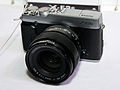
Fujifilm X70 is a pocketable APS-C fixed-lens compact with a 28mm-equivalent f/2.8 lens, a tilting touchscreen and a 16.3 MP X-Trans II sensor. No viewfinder, no IBIS, 1080p/60, 8 fps. Discontinued. Launched at 699 USD.
Used-market street photographers who want a wide-angle fixed-lens Fuji compact.
In detail
It tends to land in bags for an older 16 MP X-Trans II sensor and the price point it launched at. Released in 2016 at 699 USD, the body is no longer in production. It sits in the X70 line, which is Fuji's one-off fixed-lens compact with a wider 28mm-equivalent lens.
Image quality out of the X-Trans sensor is solid for the price, with the usual Fuji color science baked in. At 16.3 MP, native ISO is ISO 200 to 6400, modest by modern standards, the files give you enough room to crop without falling apart. Subject detection is the older contrast-based system, which still works for portraits and slow subjects but lags behind the current AI-driven Fuji bodies for action. Burst at 8 fps is plenty for travel, family, and most outdoor work.
For a hybrid shooter the codec and resolution choices are sensible. 1080p is the cap, so this is a stills-first body. You can grab clips, but do not expect it to replace a dedicated video camera.
In the hand it feels like a Fuji, with the usual tight dials and a deep enough grip. There is no in-body stabilization, so for low light or long lenses you will lean on stabilized XF glass. At 340g it is light enough to live in a small sling bag without becoming a chore.
Battery life is 330 shots CIPA. Carrying a spare NP-95 is not optional. There is a single card slot (SD UHS-I), which is fine for most people but worth knowing if you shoot events that demand redundancy. Bottom line: the used market is where this camera makes the most sense now that it is discontinued, and you can find them in good shape for a fraction of the launch price.
Pros and cons
What we like
- Pocketable fixed 28mm-equiv f/2.8 lens
- 16.3 MP X-Trans II sensor
- Tilting touchscreen on the back
- Compact 340g body
The headline win is the pocketable fixed 28mm-equivalent f/2.8 lens, which gives you a wider angle than the X100 line in an even smaller body. Film simulation count is 5, which is the older but still solid lineup. The tilting touchscreen makes waist-level street work easy, and at 340g it disappears in a coat pocket.
Trade-offs
- Discontinued, 1080p video only
- No viewfinder, no IBIS, 49 AF points
The honest trade-off is that it is discontinued and caps at 1080p video, and there is no stabilised lens to fall back on because the lens does not come off. Single card slot is the kind of spec that does not matter until the day it does, so backup discipline is on you. The fixed lens is the whole point, but it also means you cannot swap focal lengths, and travel and everyday carry shooters tend to love it while event and wildlife shooters usually do not.
Who is this for
Used-market street photographers who want a wide-angle fixed-lens Fuji compact. Light enough that it makes a great second body or a daily-carry option. Street, travel, and everyday-carry photographers tend to fall in love with this format. It is a particularly strong pick on a budget, especially for first-time Fuji buyers.
Image quality
The X70 puts the same 16.3 MP X-Trans II sensor as the X-E2S behind a fixed 28mm-equivalent f/2.8 lens, and the pairing is the point. The lens was designed for this sensor and this body, so you get consistent corner-to-corner results without carrying anything.
16 MP is not much cropping headroom. Frame it right in the camera or accept that a tight crop is a web-sized file. Native ISO 200 to 6400 behaves the way it does on every X-Trans II body: clean to 1600, workable at 3200, and 6400 only when the alternative is no photograph.
f/2.8 on APS-C at 28mm equivalent means depth of field is generous, which is a feature for street and travel and a limitation for portraits. You are not going to blur a background into nothing. What you get instead is a lens that is sharp wide open and a camera small enough that it is with you.
Autofocus in practice
49 AF points, no subject detection, and the same X-Trans II generation autofocus as the other 2016 bodies. On a fixed 28mm lens that matters less than it would on an interchangeable-lens camera.
At 28mm equivalent and f/2.8, hyperfocal shooting covers a lot of ground. Set the focus, set the aperture, and most of the street in front of you is acceptably sharp. That is how the X70 is best used, and it sidesteps the autofocus almost entirely.
When you do use AF, single-shot on static subjects is reliable and quick enough. Continuous AF and anything moving toward you is a different matter, and the answer there is the same as on every X-Trans II body: don't. Face detection works on cooperative faces. Nothing more sophisticated is on offer.
Video verdict
1080p at 60 fps, H.264, no log. Video was not what this camera was built for and it does not pretend otherwise.
The tilting touchscreen makes framing a clip easier than on the X-E2S, and the fixed lens means no focus breathing surprises from swapping glass. That is where the advantages end. No 4K, no flat profile, and autofocus during recording that is only suitable for a locked-off shot.
If you want a pocketable camera that shoots serious video, this is not it and nothing in the X-Trans II generation is. Buy the X70 for photographs.
What makes this camera special
The screen tilts up through 180 degrees, and combined with a genuinely pocketable APS-C body that changes how you shoot.
Flip it up and you can hold the camera at waist level and shoot from the hip without the guesswork, which is the classic way to work a street scene without a lens pointed at anyone's face. Flip it all the way and it faces forward. On a camera this small, with a 28mm lens, that covers self-portraits and shooting at arm's length in a crowd.
There is no viewfinder, and that is the trade. Fuji sold an add-on optical finder for the hot shoe if you wanted one, but the body was designed around the screen. Composing on the back of a camera in bright sun is harder than composing through a finder, and no tilting mechanism fixes that. What you get in exchange is a real APS-C sensor and a real lens in a jacket pocket.
What X70 owners actually say
X70 owners talk about this camera the way people talk about a discontinued car they still drive.
The recurring sentiment on r/fujifilm is that Fujifilm made something genuinely new here and then walked away from it. One owner put it plainly in a thread about bringing an X70 out of retirement: it was innovative at the time, finally a pocketable Fujifilm with real image quality and manual controls that could go up against the Ricoh GR, and it is a shame the line was never iterated on. Another begged outright for a successor, naming the 28mm-equivalent view as their favourite focal length for everyday carry. Threads asking whether Fujifilm will ever build another one turn up every few months and always end the same way.
The comparison that dominates every discussion is the Ricoh GR, and owners are honest about the split. One who went hunting for a perfect everyday camera tried the GR line first, missed Fujifilm colour and the dials, and landed back on the X70 as the closest thing they had found. Ritchie Roesch, who has shot all of them, ranks the X70 above both the GR III and the XF10 while conceding the Ricoh is smaller and quicker.
The practical warnings from long-term owners are worth heeding on a ten-year-old body. The screws holding the tilting screen assembly work loose and go missing — more than one owner has reported it. White balance and recipe storage is limited compared with modern bodies, which is a real constraint if you shoot JPEG on custom settings.
What nobody complains about is the pictures. The threads are full of people printing 16 MP files and posting SOOC sets a decade on, and the top comment on one of them is the whole argument: gear does not mean much, stop counting megapixels and go shoot.
Is the X70 still worth buying in 2026?
The X70 has an unusual position: it is the only pocketable fixed-lens X-Trans camera Fuji ever made at 28mm, and nothing since has replaced it directly. The XF10 that followed uses a Bayer sensor. The X100 line is 35mm-equivalent with a viewfinder and a much bigger body. Fuji has not gone back to this exact recipe.
That scarcity is the main argument for buying one. If you want X-Trans color, 28mm, and a camera that disappears into a coat pocket, the X70 is the answer and the shortlist is one item long.
The arguments against are the ones you would expect from a 2016 body. 16 MP, 1080p video, no viewfinder, no weather sealing, and an autofocus system that belongs to its era. Ricoh's GR line covers the same 28mm pocket-camera brief with a different sensor and different color, and is worth checking against whatever the X70 is going for.
Because it is discontinued and there is no successor, condition matters more than usual. Look at the lens barrel and the tilting screen hinge, both of which take the wear on a camera that lives in a pocket.
Rating breakdown
| Dimension | Score |
|---|---|
| Image quality | 5 / 10 |
| Autofocus | 4 / 10 |
| Video | 2 / 10 |
| Handling | 6 / 10 |
| Value | 4 / 10 |
Sub-ratings are the author’s assessment of each dimension against the current Fujifilm APS-C lineup.
X70 release date and lifecycle
The Fujifilm X70 was announced in January 2016 and went on sale in February 2016. It was replaced by the XF10.
| Announced | |
|---|---|
| On sale | |
| Launch price | 699 USD |
| Status | Discontinued |
| Replaced by | XF10 |
Announcement and on-sale months are from Fujifilm’s launch announcements. Launch price is MSRP at release, not a used-market price.
Full specifications
| Release year | 2016 |
|---|---|
| Launch price | 699 USD |
| Status | Discontinued |
| Megapixels | 16.3 MP |
| Sensor generation | X-Trans II |
| Processor | EXR Processor II |
| ISO range | 200–6400 |
| AF points | 49 |
| Subject detection | none |
| Burst (fps) | 8 |
| Max video | 1080p 60p |
| Codec | H.264 |
| Log profile | No |
| Stabilization | None |
| Viewfinder | None |
| LCD | 3" tilt touch |
| Weather sealed | No |
| Weight | 340g |
| Card slots | 1 |
| Card types | SD UHS-I |
| Battery | NP-95 |
| Battery life (CIPA) | 330 shots |
| Film sims | 5 |
Highlighted rows are class-leading within the current Fujifilm APS-C lineup.
Film simulations (5)
- PROVIA
- Velvia
- ASTIA
- Classic Chrome
- Monochrome
Compared with



Further reading
Where to buy
The link below runs an Amazon search for this camera rather than pointing at one listing, because stock and sellers move around. As an Amazon Associate we earn from qualifying purchases — at no extra cost to you.

See it in the wild
Owner impressions and real-world photos from the Fuji community.


Sources and further reading
Specs come from Fujifilm. Measured results, other reviewers’ verdicts, and owner reports are credited to the people who did the work:
- DPReview — Fujifilm X70 review
- Kevin Mullins — ten years of the Fujifilm X70, is it still viable?
- Fstoppers — "The GR is not the only one", a Fujifilm X70 re-review
- Ritchie Roesch (Fuji X Weekly) — X70 vs XF10 vs Ricoh GR
- Mirrorless Comparison — Fujifilm X70 vs Ricoh GR II, the complete comparison
- r/fujifilm — "Brought the X70 out of retirement" (the successor that never came, and the screen screws)
- r/fujifilm — "I have a X70 now"
- r/fujifilm — "Hoping for an X70 or XF10 successor"